Near the beginning of John's Gospel, people ask Jesus for a sign proving his authority.
Jesus gives them a puzzling answer:
“Destroy this temple and in three days I will raise it up again.”
John explains that Jesus was speaking about his own body.
The final sign is therefore not simply something Jesus does for someone else. It is what happens to Jesus himself.
1. Connect
What kind of evidence would you need before believing that someone who had genuinely died was alive again?
2. Read
Read ; ; together.
This is a longer reading than our previous conversations. As you read, notice Jesus' prediction, his death, what his followers discover, and how they respond.
(NET2)
13 Now the Jewish Feast of Passover was near, so Jesus went up to Jerusalem.
14 He found in the temple courts those who were selling oxen and sheep and doves, and the money changers sitting at tables. 15 So he made a whip of cords and drove them all out of the temple courts, with the sheep and the oxen. He scattered the coins of the money changers and overturned their tables. 16 To those who sold the doves he said, “Take these things away from here! Do not make my Father’s house a marketplace!” 17 His disciples remembered that it was written, “Zeal for your house will devour me.”
18 So then the Jewish leaders responded, “What sign can you show us, since you are doing these things?” 19 Jesus replied, “Destroy this temple and in three days I will raise it up again.” 20 Then the Jewish leaders said to him, “This temple has been under construction for 46 years, and are you going to raise it up in three days?” 21 But Jesus was speaking about the temple of his body. 22 So after he was raised from the dead, his disciples remembered that he had said this, and they believed the scripture and the saying that Jesus had spoken.
(NET2)
16 Then Pilate handed him over to them to be crucified. So they took Jesus,
17 and carrying his own cross he went out to the place called “The Place of the Skull” (called in Aramaic Golgotha). 18 There they crucified him along with two others, one on each side, with Jesus in the middle. 19 Pilate also had a notice written and fastened to the cross, which read: “Jesus the Nazarene, the king of the Jews.” 20 Thus many of the Jewish residents of Jerusalem read this notice because the place where Jesus was crucified was near the city, and the notice was written in Aramaic, Latin, and Greek. 21 Then the chief priests of the Jews said to Pilate, “Do not write, ‘The king of the Jews,’ but rather, ‘This man said, I am king of the Jews.’” 22 Pilate answered, “What I have written, I have written.”
23 Now when the soldiers crucified Jesus, they took his clothes and made four shares, one for each soldier, and the tunic remained. (Now the tunic was seamless, woven from top to bottom as a single piece.) 24 So the soldiers said to one another, “Let’s not tear it, but throw dice to see who will get it.” This took place to fulfill the scripture that says, “They divided my garments among them, and for my clothing they threw dice.” So the soldiers did these things.
25 Now standing beside Jesus’ cross were his mother, his mother’s sister, Mary the wife of Clopas, and Mary Magdalene. 26 So when Jesus saw his mother and the disciple whom he loved standing there, he said to his mother, “Woman, look, here is your son!” 27 He then said to his disciple, “Look, here is your mother!” From that very time the disciple took her into his own home.
28 After this Jesus, realizing that by this time everything was completed, said (in order to fulfill the scripture), “I am thirsty!” 29 A jar full of sour wine was there, so they put a sponge soaked in sour wine on a branch of hyssop and lifted it to his mouth. 30 When he had received the sour wine, Jesus said, “It is completed!” Then he bowed his head and gave up his spirit.
(NET2)
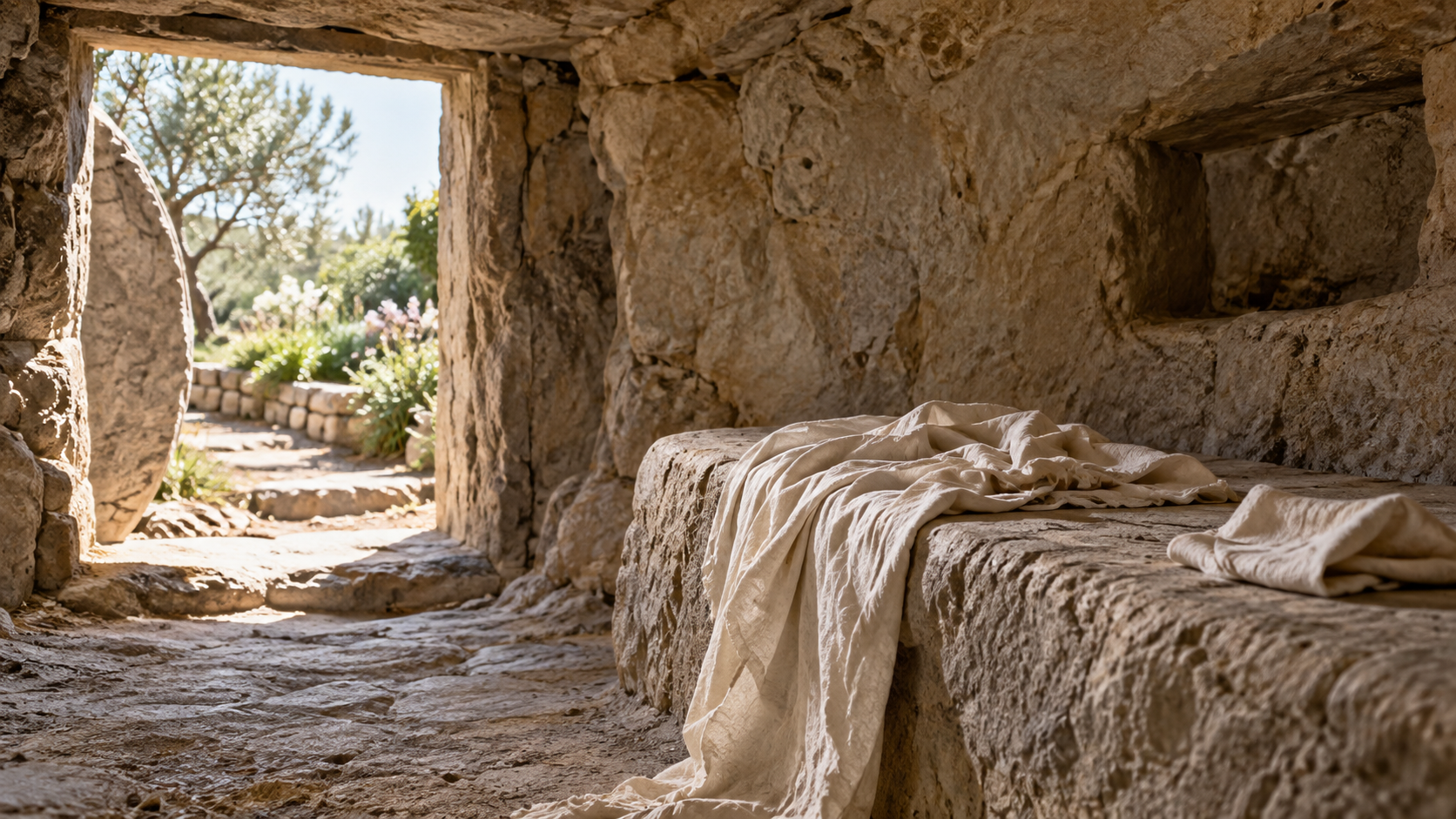
1 Now very early on the first day of the week, while it was still dark, Mary Magdalene came to the tomb and saw that the stone had been moved away from the entrance. 2 So she went running to Simon Peter and the other disciple whom Jesus loved and told them, “They have taken the Lord from the tomb, and we don’t know where they have put him!” 3 Then Peter and the other disciple set out to go to the tomb. 4 The two were running together, but the other disciple ran faster than Peter and reached the tomb first. 5 He bent down and saw the strips of linen cloth lying there, but he did not go in. 6 Then Simon Peter, who had been following him, arrived and went right into the tomb. He saw the strips of linen cloth lying there, 7 and the face cloth, which had been around Jesus’ head, not lying with the strips of linen cloth but rolled up in a place by itself. 8 Then the other disciple, who had reached the tomb first, came in, and he saw and believed. 9 (For they did not yet understand the scripture that Jesus must rise from the dead.)
10 So the disciples went back to their homes. 11 But Mary stood outside the tomb weeping. As she wept, she bent down and looked into the tomb. 12 And she saw two angels in white sitting where Jesus’ body had been lying, one at the head and one at the feet. 13 They said to her, “Woman, why are you weeping?” Mary replied, “They have taken my Lord away, and I do not know where they have put him!” 14 When she had said this, she turned around and saw Jesus standing there, but she did not know that it was Jesus.
15 Jesus said to her, “Woman, why are you weeping? Who are you looking for?” Because she thought he was the gardener, she said to him, “Sir, if you have carried him away, tell me where you have put him, and I will take him.” 16 Jesus said to her, “Mary.” She turned and said to him in Aramaic, “Rabboni” (which means “Teacher”). 17 Jesus replied, “Do not touch me, for I have not yet ascended to my Father. Go to my brothers and tell them, ‘I am ascending to my Father and your Father, to my God and your God.’” 18 Mary Magdalene came and informed the disciples, “I have seen the Lord!” And she told them what Jesus had said to her.
19 On the evening of that day, the first day of the week, the disciples had gathered together and locked the doors of the place because they were afraid of the Jewish leaders. Jesus came and stood among them and said to them, “Peace be with you.” 20 When he had said this, he showed them his hands and his side. Then the disciples rejoiced when they saw the Lord. 21 So Jesus said to them again, “Peace be with you. Just as the Father has sent me, I also send you.” 22 And after he said this, he breathed on them and said, “Receive the Holy Spirit. 23 If you forgive anyone’s sins, they are forgiven; if you retain anyone’s sins, they are retained.”
24 Now Thomas (called Didymus), one of the twelve, was not with them when Jesus came. 25 The other disciples told him, “We have seen the Lord!” But he replied, “Unless I see the wounds from the nails in his hands, and put my finger into the wounds from the nails, and put my hand into his side, I will never believe it!”
26 Eight days later the disciples were again together in the house, and Thomas was with them. Although the doors were locked, Jesus came and stood among them and said, “Peace be with you!” 27 Then he said to Thomas, “Put your finger here, and examine my hands. Extend your hand and put it into my side. Do not continue in your unbelief, but believe.” 28 Thomas replied to him, “My Lord and my God!” 29 Jesus said to him, “Have you believed because you have seen me? Blessed are the people who have not seen and yet have believed.”
30 Now Jesus performed many other miraculous signs in the presence of the disciples, which are not recorded in this book. 31 But these are recorded so that you may believe that Jesus is the Christ, the Son of God, and that by believing you may have life in his name.
What caught your attention?
3. Explore
Look back at the passages as you discuss these questions.
- In , what sign does Jesus say will demonstrate his authority? What does John explain that Jesus means?
- What details in indicate that Jesus really dies?
- What do Mary, Peter, and the other disciple discover at the tomb?
- Why does Thomas initially refuse to believe that Jesus has risen? What evidence does he say he would need?
- What happens when Thomas finally encounters the risen Jesus? How does he respond?
- According to , why does John say he recorded these signs?
4. Consider
Thomas sees the risen Jesus and responds:
“My Lord and my God!”
Think back over the signs we have investigated:
- Water became wine.
- A dying child was healed from a distance.
- A man disabled for thirty-eight years stood up and walked.
- Thousands were fed from five loaves and two fish.
- Jesus walked across the sea.
- A man born blind received his sight.
- Lazarus walked out of his tomb.
- And now John presents Jesus himself as crucified, buried, and risen.
John does not present these simply as remarkable events. He calls them signs. They point beyond themselves to Jesus.
- Taken together, what do these signs suggest about Jesus?
- How does Jesus' resurrection affect the way you understand the earlier signs?
- What do you think Thomas means when he calls Jesus “my Lord and my God”?
- Which of the signs have you found most compelling or thought-provoking? Why?
- What questions or difficulties do you still have?
5. Respond
At the beginning of this course, you were invited simply to investigate the evidence.
John now tells us why he recorded it:
“These are recorded so that you may believe that Jesus is the Christ, the Son of God, and that by believing you may have life in his name.”
John is not merely asking:
“Do you believe that these signs happened?”
He wants us to consider what the signs reveal about Jesus himself.
So we finish with the question that has followed us through all eight conversations:
What do these signs reveal about Jesus?
And now a more personal question:
After everything you have investigated, who do you think Jesus is?
If you believe John's account is true, there is one further question worth considering:
What would keep you from trusting Jesus and receiving the life he offers?
Where From Here?
You have now investigated eight remarkable signs from John's Gospel.
But John's Gospel contains much more.
If you still have questions, keep asking them. Keep reading John. Talk honestly about your doubts and objections with the person who has been exploring these passages with you.
You do not need to pretend that every question has been answered.
But don't miss John's central claim.
The signs are not ultimately about wine, healing, bread, storms, sight, or even Lazarus.
The signs point to Jesus.
John wants us to see that Jesus is the Christ, the Son of God, and that the life we are searching for is found in him.
If You're Not Ready to Believe
Keep investigating.
You might read John's Gospel from beginning to end and ask two questions as you go:
What does this tell me about Jesus?
What response does Jesus invite from me?
Keep bringing your questions. Christianity does not require you to stop thinking or asking.
If You're Ready to Trust Jesus
Tell the person who has been going through these conversations with you.
Ask them to help you understand what it means to trust Christ, receive his forgiveness, and begin following him.
Becoming a Christian is not simply agreeing that Jesus existed or even believing that he performed miracles.
It is placing your trust in Jesus himself.
John describes it this way:
Believe in him—and receive life in his name.
And if you are ready to begin following Jesus, D3DStart is designed to help you take those first steps.
That You May Believe
We began with a question:
Why should anyone believe Jesus' extraordinary claims?
John's answer is an invitation:
Look at the signs.
Consider what they reveal.
Decide what you think about Jesus.
And hear again the reason John says he wrote them down:
“These are recorded so that you may believe that Jesus is the Christ, the Son of God, and that by believing you may have life in his name.”